Are MMM implementation approaches creating challenges for affiliate marketing?
There is plenty of chatter around Media Mix Modelling (MMM) right now. Moonpull wishes to see publishers fairly rewarded for their promotions and advertisers pay the appropriate amount for activity through the model. Tracking and measurement are essential to this and this is what we monitor at scale for affiliate marketers. Therefore, through a 'measurement' lens we've been musing on MMM.
As privacy changes continue to impact traditional digital tracking, brands are turning back to macro-level econometrics — MMM — to help guide budget allocation. It makes sense on paper. But it raises a question for affiliate marketers.
Does affiliate marketing carry structural complexities that other digital channels simply do not?
Rewarding vs measuring
Perhaps what we are seeing is a growing, unaddressed friction between two different components of performance marketing: the basis for rewarding a partner vs. measuring their value to a brand.

Two approaches each to a different task. One is to rewarding the publisher, the other to determining the value the partnership provides.
Affiliate marketing involves partners being compensated on one independent dataset (network performance data typically being a post-activity CPA from deterministic last-click appraisal), while the brand's leadership evaluates the channel's strategic value using different datasets (including methods such as GA4 attribution, or now, top-down MMM).
When reward calculations and strategic valuation rely on separate datasets — especially if there is not close alignment of the two — different views of "what success looks like" are inevitable.
Does MMM have an "elasticity" conundrum?
There is a possibility that MMM algorithms might favour channels with more measurable elasticity. Increase spend on Paid Search or Social today, and the regression model in use might be correctly honed for detecting a corresponding uplift in clicks and sales according to elasticity views of those promotions.
Affiliate marketing operates differently to those channels. If you adjust a commission rate or alter your publisher mix, the impact takes time to filter through to content production, publisher placements and the lag between click and sale (the profile of which might change with changing promotions and is certainly different for different brands and products).
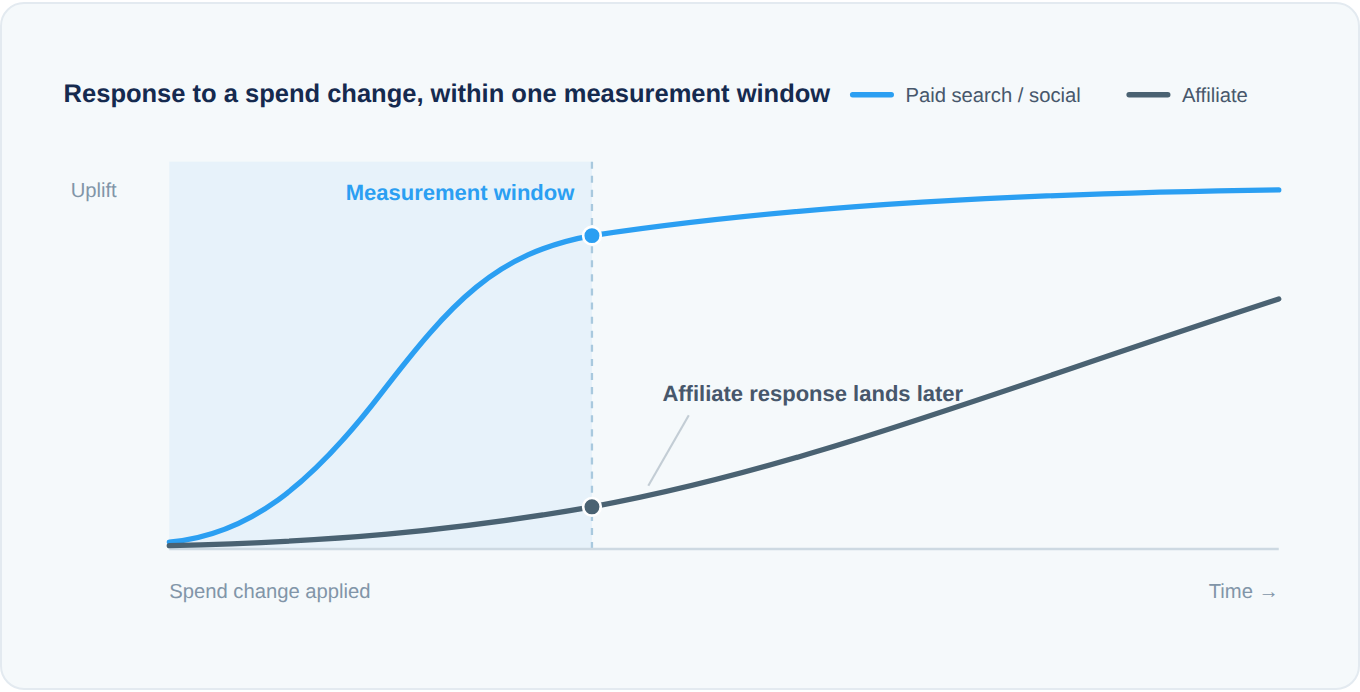
In this example most of the affiliate response lands after the measurement window closes.
If the mathematically appraised outcome doesn't move immediately or significantly during a given measurement window, the implemented MMM could easily conclude the overall business performance is relatively "inelastic" to affiliate channel changes. A corporate response may be to focus budget on the channels the model can easily see the elasticity of response, while scaling back on those it can't.
The threefold pressure on affiliate marketers
Affiliate marketers are currently navigating three developments:
1. GA4 / attribution. Such analytics can often fail to assign value to affiliate activity that matches the affiliate tracking measurement.
2. MMM. MMM may not identify sufficiently accurately how affiliate performance responds to changing affiliate spend, and draw a conclusion that it is more inelastic than it is, and potentially less relevant to business performance than it is.
3. LLMs and AI search engines. These are utilising publisher content to answer user queries directly, driving outcomes for the brands without always involving a traditional affiliate click. Therefore affiliate content publishers' contributions go unrecognised, without a secondary reward mechanism for this scenario.
Stating the obvious, when a click isn't present in the user journey to be captured, deterministic tracking cannot reflect the publisher's contribution — even when affiliate content played a role in the sale.
Where does this leave affiliate marketing?
1. Accurate deterministic tracking is non-negotiable. If affiliate marketing is already losing click attribution measurement to AI and zero-click searches, the tracking that does exist for click-based referral must be as accurate as possible. Affiliate's own measurement model cannot be under-reporting — otherwise it is not in the best position possible to provide data to support performance appraisal investigations.
2. Understanding and demonstrating "elasticity" is a growing priority. Networks, publishers, and affiliate managers need to proactively communicate the performance response of their use of affiliate marketing to their partners.
3. Encourage measurement triangulation. Relying solely on network tracking, solely on GA4, or solely on MMM will almost inevitably lead to incomplete or over-simplistic conclusions. When using all three, they need to be pulling in the same direction. Perhaps the nuances of each are: network tracking for operational settlement, GA4 for tactical insight, and MMM (with proper sub-channel granularity) for macro budget allocation.
4. Understand and measure user behaviour in AI platforms. This is a rapidly evolving area and must be embraced to best understand the contributions of publishers using affiliate-based relationships to partner with brands.
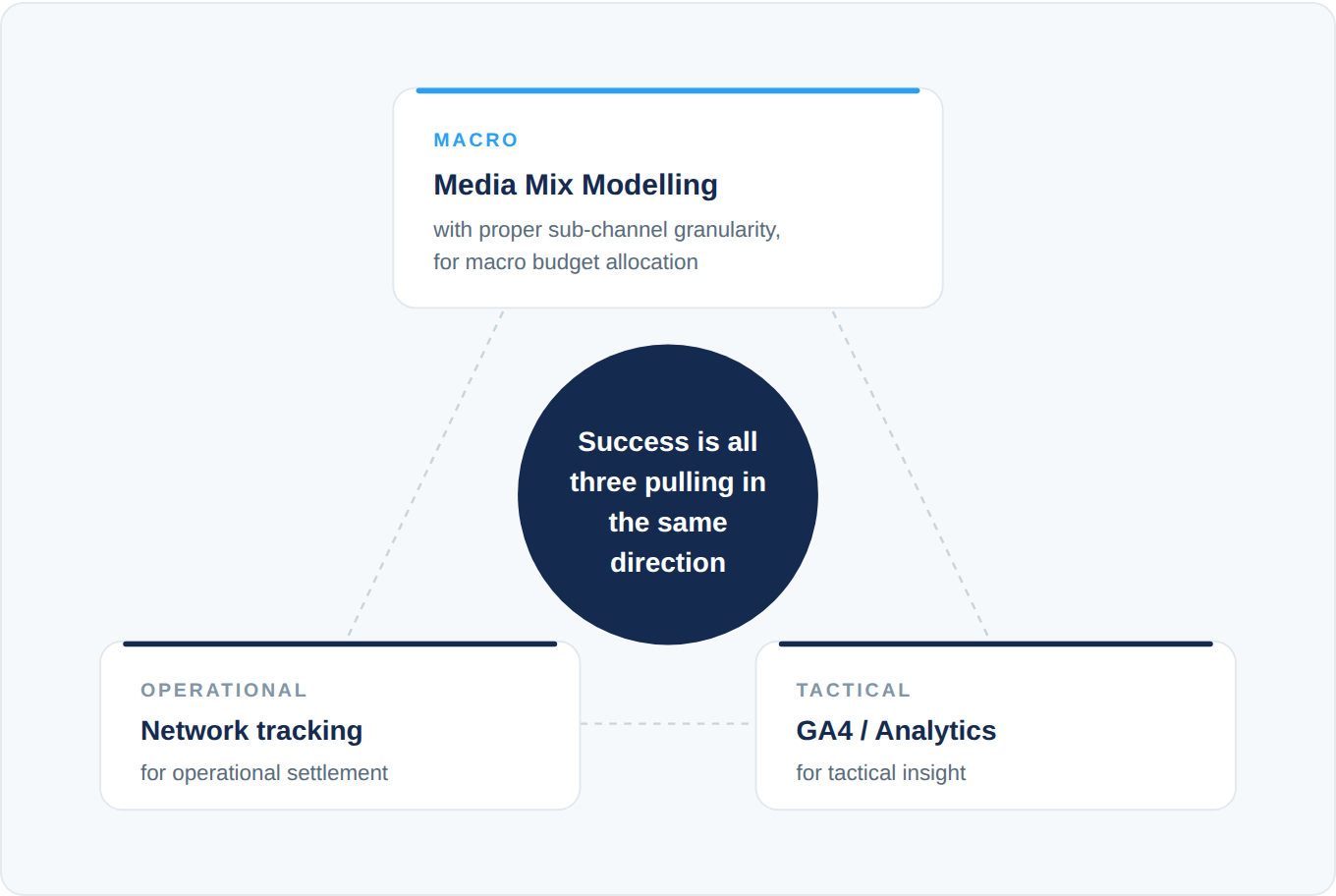
Three measurement systems, three distinct jobs.
The Trust Gap
If affiliate marketers don't address the gaps between how they compensate partners and how they evaluate them mathematically, trust issues in affiliate marketing will remain. Closing the trust gap is crucial for brands to have confidence in allocating the appropriate resources to affiliate partnerships.
What's your take? Are you seeing this reward vs. measurement dynamic play out in your partnership discussions? How would you correct or nuance these views?