
Managing deprecation -- the learnings from vouchergeddon
Chrome deprecation is still alive, albeit in a new guise! Before discussing this, here's a spin through the voucher/coupon industry's interaction with Google.
Google turns the Coupon world upside down
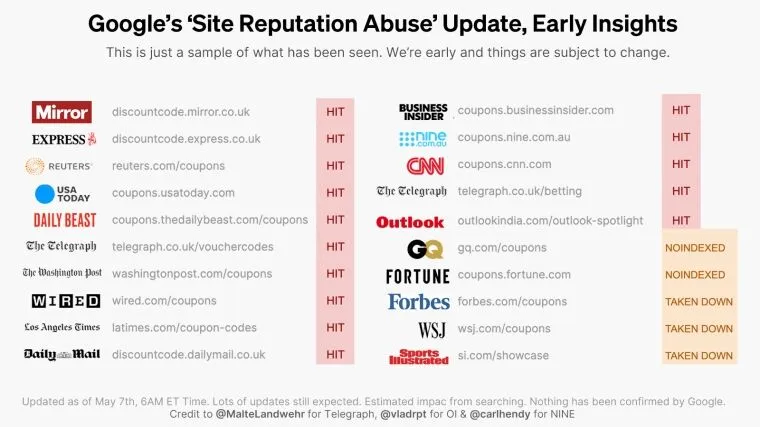
Google in their 6 May update, cited "site reputation abuse" as the reason for taking the coupon and vouchercode sector head on. High reputation news websites had been adding subdomains to host coupon content from specialist third-party providers, to add value for their readers.
Google stated:
"when third-party pages are published with little or no first-party oversight or involvement, where the purpose is to manipulate Search rankings by taking advantage of the first-party site's ranking signals. Such third-party pages include sponsored, advertising, partner, or other third-party pages that are typically independent of a host site's main purpose or produced without close oversight or involvement of the host site, and provide little to no value to users"
The impact that Google's flicking of the switch had on the voucher code industry was immediate. The impacted publishers had approximately two months' warning from the initial announcement to Google making its changes as reported by Coupons in the News, and there have been significant winners and losers (as reported by Hello Partner):
"Even though Google initially suggested that legitimate businesses would not be affected by this, the aftermath of Sunday's rollout has proven otherwise. There's been a near total wipeout of news sites hosting coupons from its SERPs with little-to-no discrimination shown for whether a business takes 'active involvement' in its partnerships or not.
On the flip side, first-party coupon sites have fared well in all of this. Unaffected by Google's policy, these sites are now sitting at the top of SERPs for coupon-related search queries, not surrounded by much competition."
Partnerize in their assessment in May shared this detail from @MalteLandwehr which shows a mix of subdomains and website sub-pages hosting the coupon content.
"In the first few weeks following the update, significant traffic drops were experienced by many of these websites in countries such as the United States, Australia, and the United Kingdom. In other countries, the changes have not yet been as significant."
What learnings can be taken and applied to Google's third party cookie changes?
We've seen in the last two weeks that Google is not afraid to change its mind. It's scrapped its deprecation approach and timetable, and replaced it with something that sounds like it'll have an end result a lot like deprecation -- at least to the affiliate industry -- but on an unknown timescale.
Google's own sites had little mention of the change, which was reported mostly by third parties.
We see its messaging changing weekly.
Currently Google have provided no timeline and little product vision for its third-party consent roll out
Google has replaced a defined approach to deprecation with a timeline with a product change without a timeline.
Weekly changes to their messaging at https://developers.google.com/privacy-sandbox/3pcd continue to include "3pcd" in the url.
- Announcement on 22nd July
- 23rd July (which included a timeline of deprecation) and when this article was first written...
- 30th July this changed and excluded the timeline of deprecation (page recovered from Archiv.org)
- 1st August -- the language changed to that of user consent opt-out; still the current status on date of publication.
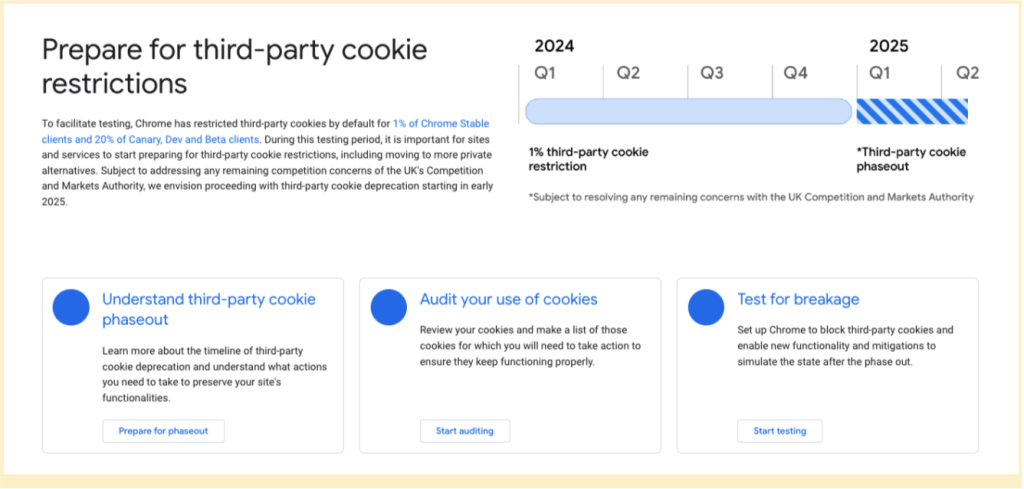
The three steps recommended by Google remain very apposite. Internet marketers can't really say they haven't been warned or advised to prepare.
It's possible that the third party consent approach could be announced and implemented within 2 months, like 'Vouchergeddon'. Google has clearly thought about their change, but not put much information into the public domain. We're not seasoned Google watchers, but we do feel this is potentially relevant. It's difficult to read too much into the changing timeline on the Google site lagging the announcement. Again it's perhaps a little curious and something to consider in your planning.
Preparing for reliance on first party cookies
The affiliate industry has come to use 'deprecation' to represent the shift to a first-party world. We'll continue to use it for this purpose, although in many cases it will actually be encompassing Google's shift to requiring consent for third party cookies.
As Jim Nichols stated on LinkedIn: "One worrying fact about cookie deprecation is that many companies THINK they have correctly implemented first-party tracking but haven't. Instead, their old third-party tracking cookies are capturing the actions as a backup to improperly implemented first-party tracking."
The impact has already been seen on Safari and Firefox, which have negated third-party tracking for close on seven years. So given that these account for 20-30% of browser sessions, that means this 20-30% proportion has gone untracked and largely un-noticed for nearly 7 years on many programs. That proportion may be higher on mobile focused or GenZ audiences.
It's worth reflecting on the words from:
Angela Ballard of CJ in a Q&A for the APMA, wrote: "Tracking customer journeys the way we used to just isn't possible, and accurate tracking requires comprehensive solutions that need to be adopted by both publishers and advertisers."
<!-- Video embed: https://www.youtube.com/watch?v=E8cI7KgstUE -->Todd Crawford of Impact.com who suggested to Dustin Howes in an Affiliate Nerd Out podcast, that the industry should look 'beyond CPA and Rev Share' and a hybrid approach makes more sense. That certainly applies in the 'creator' sector, where an effective CPC or placement fee may be required with some of the key publisher partners to achieve the ideal 'return on Ad-spend' for advertisers -- and revenue expectations for publishers.
Summary
Just like with the voucher code change there will be winners and losers. The aim here is to be a winner. And this is the diligent adoption and maintenance of first party tracking, which the industry must accept becomes more complex because much first party affiliate tracking requires consent -- not due to a Google decision -- but due to laws like PECR, GDPR and CCPA.
The key is to follow Google's advice and prepare. Don't wait for a deadline to approach as it is possible that the timeline could follow the two-month 'announcement to action' period for the coupon industry. Equally, does Google think it's made the announcement already and the clock is ticking?