Networks come together to address User Consent
Last week, Moonpull gathered together seven of the main affiliate networks, along with many of the UK's leading publishers and agencies into a room for its "User Consent -- we need to talk" mini-conference.
We were very pleased to hear from more than one attendee that it was the best affiliate event they'd attended. Our thanks go to the panel and the delegates for being so open with each other for making this such a strong event!
The mini-conference was also reported on by HelloPartner.
Setting the Scene
Moonpull's Lorena Brazil, Head of Client Services; and Dan Amarquaye, Head of Sales set the scene by addressing two key questions:
- How frequently is consent required for first party tracking?
- How frequently is consent given?
Lorena outlined the variations that we see in approaches used by advertisers for gathering consent, even for those using a common Consent Management Platform (CMP provider). She presented six quite distinct variations from OneTrust (the most frequently used in affiliate commerce) with regards to their presentation and terminology for gathering consent.
Dan concluded by sharing some key metrics we see in Moonpull data:
- 67% of affiliate promotions in the UK require consent for first party tracking
- Data from Advance Metrics and the Drum suggest between 25% and 50% of people grant consent.
He explained the context to these numbers; the calculation of 67% is based on weighting affiliate traffic volumes for the largest online advertisers (according to Retail Week) to retailer size and then overlaying the consent requirements of each of the advertisers.
Across all retailers, Moonpull's data -- based on the advertisers most frequently audited in the platform -- reveals that 32% of UK advertisers require consent for first party tracking. The requirement for consent is therefore skewed towards the largest advertisers -- which concurs with many anecdotal views but doesn't provide comfort for the affiliate channel. Moonpull sees this correlation in other markets, including the US, where the largest advertisers are the earlier adopters of requiring consent for affiliate first party tracking.
The Panel
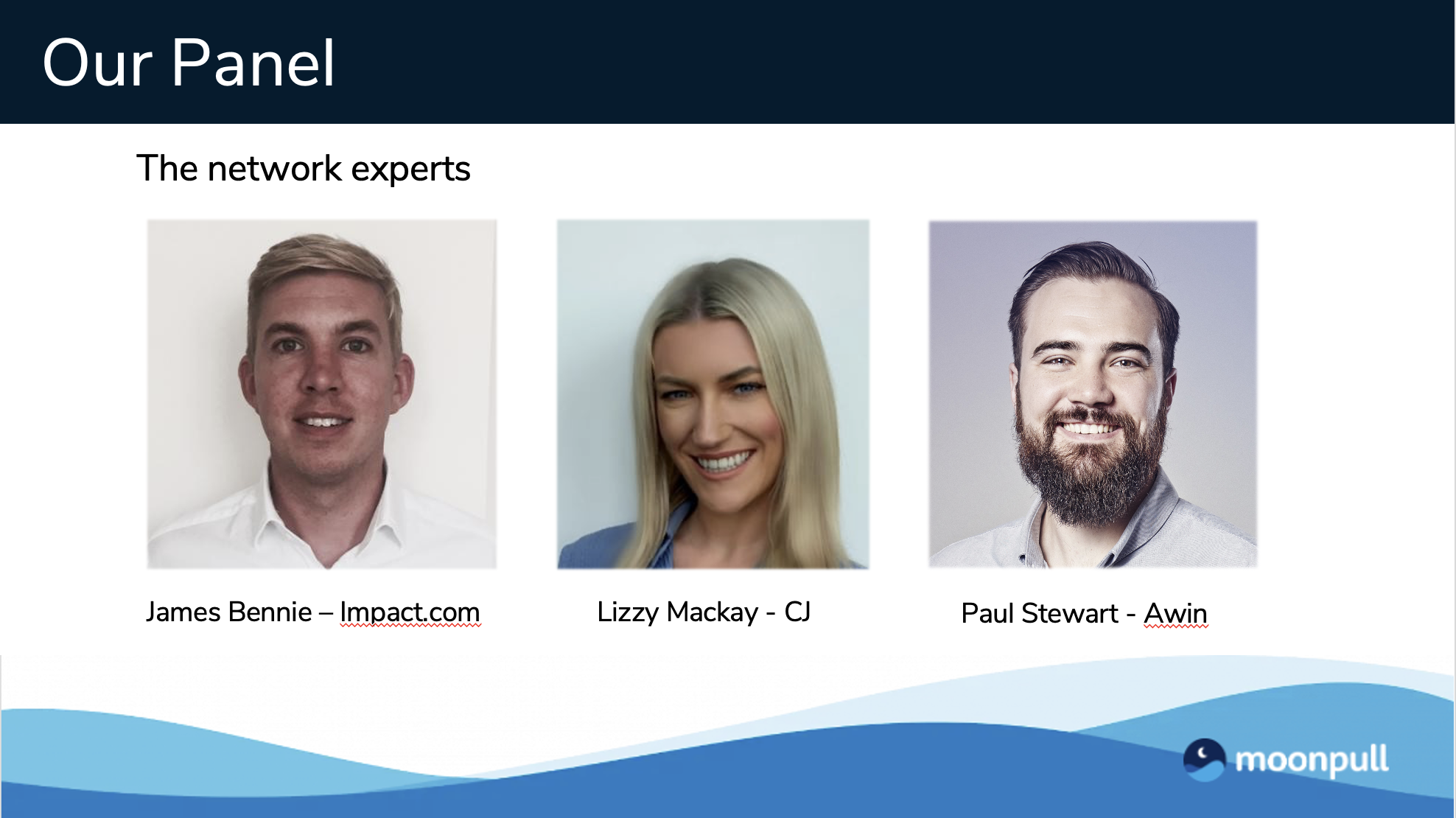
Firstly, we want to thank the panel and their businesses for being willing to participate together to discuss such a topic, from a channel perspective and with no desire to seek competitive advantage within the conversation.
The panel was:
- Paul Stewart -- Group Strategic Partnership Director, Awin
- Lizzy Mackay -- Director of Partner Solutions, CJ
- James Bennie -- Vice President of Customer Success, Impact.com
With Steven Brown of Moonpull as the moderator.
The panel discussion followed a wide ranging discussion on some of the key areas concerning the effect of user consent on affiliate tracking.
Takeaway 1. Consent is being taken seriously
It was clear the panel were well prepared and comfortable together as they recognised that the impact of the requirement for user consent across the industry is significant and that it needs their focus to lead both publishers and advertisers.
Indeed, as one network attendee in the audience commented afterwards, "it was beneficial to understand how competing networks are tackling the nuances with CMPs & how merchants view rolling out affiliate tracking -- the challenges we face are certainly not isolated to us alone".
This perspective was rolled into the conclusion that the networks need to double down together to lead the industry through the challenges.
In terms of the significance, Paul shared an advertiser example: "For one telecoms provider that made quite a radical change for consent, we saw conversion drop for their partners by 70%". This was addressed very quickly once the significance of the change was identified, "but these decisions can have that kind of impact overnight".
Takeaway 2. Plans are afoot for looking at the measurement model
All the networks have plans in place for moving beyond a straight CPA model where deemed necessary.
Takeaway 3. Loyalty and cashback technology
All three networks recognise that, in many territories, the regulators accept the rationale for a loyalty or cashback publisher to have their memory cookie appear before consent on the basis of being an "essential" one. They all have technology for handling the passing or identification of the user as being one where their cookie on the user's device could be set according to it being deemed as essential. However there is a need for rolling it out more widely.
In the UK there was the anticipation of the ICO addressing this matter positively, which actually happened the day following the mini-conference -- read the ICO response. Congratulations and thanks go to James Little for taking the lead on the issue on behalf of the wider industry.
Takeaway 4. Publishers are feeling the pain
The publishers in the room certainly expressed the view that they're feeling the pain of consent, although some more than others. One leading publisher shared "we've probably lost £20m this year alone -- and we're not even at peak yet" -- with another commenting: "Advertisers need to realise this is meant to be a partnership and realise there is a big problem here and do something about it".
There was a debate involving the audience about the responsibility of the different participants regarding the best steps -- and by whom -- for addressing the impact of consent.
At one point the discussion was a little heated, reflecting there are no easy answers.
Takeaway 5. A collaborative approach across the industry is needed
The networks committed to continue to stay close to each other on this matter, and they welcome trade body involvement to ensure that any legal issues from acting collaboratively are mitigated. Kevin Edwards from the APMA took note, and the PMA will too (not least as Moonpull's Chris Tradgett sits on the PMA Board). There was also a desire for a common terminology, and here's the Moonpull suggestion following our roundtable last year.
There was also discussion for a requirement for a standard to be implemented across the industry, which supports the rationale for Moonpull's Certification; the initial implementation helps recognise digital agencies that take the tracking of their clients seriously. The certification badge is looking to be extended to advertisers and networks in the same vein, giving the foundation to a standard that all parties should adhere to.

The discussion after the event was lively -- and we thank Finfare for providing a great space -- with a leading publisher congratulating Moonpull for "getting the right people in the room and facilitating active discussions".
Indeed many participants decamped to another venue where the conversations kept flowing.
The Main Takeaway
Perhaps the biggest takeaway is that User Consent is a CEO-level issue at every network. All networks are either performance remunerated or recognise maintaining performance revenues is key to their futures. The same applies to agencies, whether remunerated on a performance basis, or judged on the performance of the programs under their management.
User Consent, and its effect on affiliate tracking, is set to be a key topic of conversation across the affiliate industry for some time to come, as the title of the event suggested: